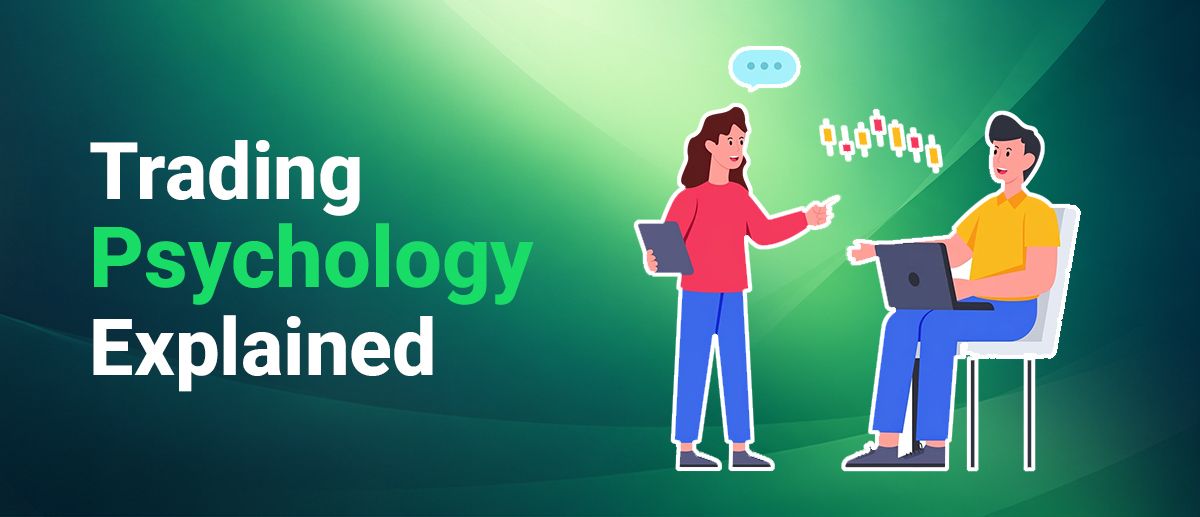


Trading psychology refers to the mental and emotional states that influence a trader’s decision-making process. Emotions such as fear, greed and overconfidence can affect how traders assess risks and respond to market fluctuations. That is why understanding psychology in the stock market helps traders follow a trading plan and avoid over-trading.
Additionally, traders have to manage different types of cognitive and emotional biases while trading. This way, you will not be among the 90% of traders who exit the stock market in the first 3 years.
Let us understand trading psychology, common emotions of traders, and how to manage them.
What is Trading Psychology?
Trading psychology is the feelings and behaviour a trader encounters while trading. Traders have complex emotions. When they buy and sell securities in financial markets, it triggers a unique combination of money and uncertainty tied to high-stakes psychological reactions.
For example, a trader may continue holding a declining stock because they like the company’s products or believe its price will eventually recover. However, personal familiarity with a company does not necessarily mean its stock is a sound investment.
This type of emotion does not allow them to consider other factual data and risks involved in it. Although these emotions are not always risky, you need to curb them to avoid major losses. Traders who have better control of their feelings and have a strong trading psychology can make more logical decisions.
Why Does Trading Psychology Matter?
Trading psychology matters because emotions and behavioural biases can influence how traders respond to market fluctuations. It is interesting to note that, according to Reuters, Indian equity derivative traders incurred ₹916.85 billion in losses in FY2026. Such a huge amount of loss indicates a certain psychology working among traders.
Let us explore how trading psychology can benefit a trader:
- Proper trading psychology helps traders follow a predetermined trading plan.
- Traders can also avoid over-trading while following a trading plan.
- It also helps traders control risk in the market.
- Trading psychology helps them wait for the right opportunities rather than rushing into a random asset.
- Traders may use position trading to control market exposure and set stop-loss levels to limit losses.
- Lastly, a proper trading approach restricts traders from chasing the market and helps them learn from losing trades.
What are the Common Emotions of Traders That Influence Trading Decisions?
Stock market trading involves both emotions and analysis. Here are some common emotions that can affect your trading decisions:
Fear
Fear is one of the common emotions, which is a natural reaction to perceived threat. This emotion can cause traders to exit winning trades very early, not sell a losing trade, and hold back planned trades. This can ultimately result in losses or not capitalising on more profits.
Warren Buffett once said, “Be fearful when others are greedy, and greedy when others are fearful.” This highlights the importance of not following market trends.
Tip: Traders should assess the underlying facts, valuation, risks and suitability of a trade before making a decision. Stay informed about the securities you are interested in by tracking company announcements, market developments, and economic indicators.
Hope
Although hope is a positive emotion, it can also lead to huge losses. For instance, you might hope that the price of a stock will return after your original setup failed. Traders who cannot control mindless hope can destroy their funds with wrong decisions. Mindless hope can be dangerous when traders use it as a reason to hold a losing position.
Tip: Your trading decision should depend on the strategy and the available information. Select financial goals that mirror your available funds, your capacity to take on risk, and your market experience.
Greed
Greed typically comes to a trader’s mind when he or she starts to make a profit. The trader can make more profit by extending the position beyond their goal or by raising a position size. Greed can turn a disciplined trade into an unnecessarily risky trade.
Greed comes to mind if the markets are bullish and prices are rising. This pushes traders to keep winning positions longer than suggested and ignore warning signals.
Tip: Balancing your realistic expectations with optimism can help you avoid decisions driven mainly by the desire for higher gains. Avoid unrealistic and excessive trading.
Understand the markets better and detect any stock market opportunity with the ‘Stoxkart Autotrender’ section. With this feature, you can also get precise market scanning, get expert insights, and make informed decisions.
Regret
Regret may come when you miss an opportunity or experience an unsuccessful decision. For instance, you may avoid buying securities that rise later, and then you feel disappointed for ot buying them. Repeatedly thinking about the missed opportunity can lead to impulsive decisions, such as entering a stock at a much higher price without analysing the risks.
Tip: Traders can manage regret by accepting that no strategy captures every market opportunity. Look for professional guidance, enrol in stock market courses, or reach out to a SEBI-registered investment advisor to verify whether a trade fits your goals.
Ego
Confidence can help you make better decisions in the stock market, but ego can leave you in a false position in trading. You might find it difficult to accept that you can make incorrect decisions. As a result, you might start increasing position sizes or take situations that are outside your regular criteria.
Tip: Maintaining a trading journal, reviewing mistakes objectively and following risk management rules can help traders avoid decisions driven by ego. Review your past trading mistakes and identify exactly what shaped your trading decisions.
FOMO
Fear of Missing Out (FOMO) is a social anxiety that starts from the thought that others are benefiting from a market opportunity that you are missing out on. This type of emotion makes traders take positions after a sharp price movement, when it has already moved significantly. This can increase the risk and reduce the positive impact of your analysis.
For instance, a stock is suddenly up 10% in the morning after a breakout. Seeing news about its quick gains, you rush to buy it at a higher price without checking its support levels or risk-reward ratios. However, within an hour, profit-booking kicks in, the price drops sharply, and you are left holding a losing position at the top.
Tip: To manage FOMO, traders should use technology to determine predefined entry criteria and avoid entering positions solely because a stock is rising or attracting attention.
Psychological Biases Every Trader Must Know
Psychology and trading are closely linked, and they involve managing emotional and cognitive biases that can affect decision-making and lead to impulsive trades. Let us analyse these biases in more detail:
Confirmation Bias
This entails seeking information that backs pre-existing beliefs while avoiding conflicting information. Traders can reduce this bias by considering both positive and negative information before making a decision.
Overconfidence Bias
This overestimates personal ability to predict market movements. It may encourage excessive trading or taking risks beyond predefined limits.
Recency Bias
Recency bias in stock trading involves overestimating personal ability to predict movements in the market. For example, a trader may assume that a stock will continue rising because it has performed well over the past few sessions.
Anchoring Bias
This depends excessively on primary data, purchase price, and other information while making decisions. Traders should reassess positions using current information rather than treating an earlier price as a reliable indicator of future value.
Familiarity Bias
The tendency to favour companies, sectors or assets that are familiar. This can limit the range of opportunities a trader considers and may contribute to inadequate diversification in an investment portfolio.
Loss Aversion
It is the tendency to avoid losses rather than acquiring any gains. This may cause traders to hold losing positions for too long or exit profitable positions prematurely.
Revenge Trading
This entails placing a trade just after a loss to make up for it. It can lead to impulsive decisions, excessive trading and further losses.
Final Thoughts
The stock market is unpredictable and unstable. In addition, no one can predict which way the price of any given stock will move. Although certain indicators may point to a particular trend, any outside factor can turn that trend around almost instantly.
Therefore, maintaining emotional balance and following proper trading psychology matters when making strategic trading decisions.
If you are new to stock market trading, download the Stoxkart application and open a demat account for free! Choose the Smart Trader Plan to enjoy zero brokerage on trading.