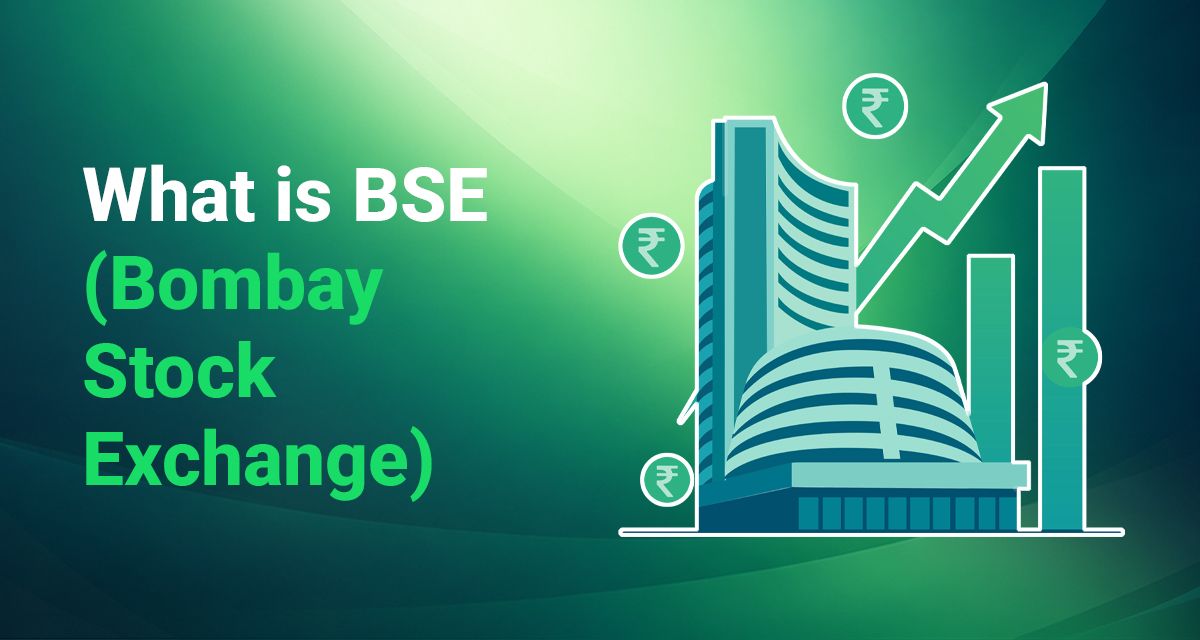


The Bombay Stock Exchange (BSE), established in 1875, is Asia’s oldest stock exchange and operates under the legal name BSE Limited. It provides an organised marketplace where companies can list their securities and investors trade them through registered stockbrokers.
According to Business Standard, BSE’s national average daily turnover (ADTO) for the year-to-date financial year 2026 stands at ₹213 trillion. Additionally, the brokerage firm expects it to be ₹216 trillion in 2027. This high turnover shows it is a reliable, transparent stock exchange platform.
Explore this article to understand the functions of BSE, advantages and how it facilitates trading.
What Are the Functions of BSE?
Providing an organised trading platform, supporting price discovery and helping companies access capital are some of the major functions of BSE. The exchange establishes the systems and rules that facilitate securities trading and promote transparency in the market.
Here are some of its key functions:
Provides an Organised Trading Platform
BSE provides an electronic trading platform that enables investors to buy and sell eligible securities through registered trading members (stockbrokers). This stock exchange can route, match, and execute eligible compatible buy and sell orders according to the applicable trading rules.
Supports Price Discovery
Price discovery is a dynamic process through which the market determines the price of a security based on demand and supply. By evaluating data points, this stock exchange establishes equilibrium market prices. Factors such as investor sentiment, company performance, and economic conditions can influence prices in the securities trade.
Facilitates Capital Raising
Another function of BSE is that it provides companies with access to the capital market by facilitating the listing and trading of securities. Eligible companies can raise funds and scale operations through the issuance of equities, bonds and other permitted securities.
This allows businesses to access capital from retail and institutional investors to support expansion, repay debt or meet other corporate requirements.
Establishes Listing and Trading Requirements
The BSE enforces strict frameworks and regulatory rules to protect public funds. For instance, listed companies must comply with continuous disclosure norms. They have to report material corporate developments and audited financials. It maintains the overall integrity of the capital market and minimises information asymmetry.
Disseminates Market Information
BSE publishes real-time financial data to media outlets, brokerages and investors globally. It helps to keep broadcast live stock prices, transaction volumes, and index movements. Additionally, it provides access to verified market intelligence, empowering participants to make data-backed financial decisions.
Supports Clearing and Settlement
After a trade is executed, the BSE coordinates clearing and settlement to manage post-trade lifecycles. It also assesses counterparty default risk, bringing operational stability to the Indian financial ecosystem. This process helps ensure that funds and securities are transferred according to the applicable settlement rules.
Interested in investing in companies’ stocks? Contact Stoxkart today to access 5000+ stocks, including BSE-listed companies, for high-speed execution.
What Are the Advantages of Listing on BSE Limited?
The advantages of listing on BSE Limited include access to capital markets, greater visibility, and a platform for trading their securities. These functions of BSE safeguard both companies’ capital and individual funds, preventing fraudulent activities.
Beginner investors often wonder, ‘Why do companies list their shares on the BSE?’ Companies list their shares on BSE to raise capital and build market presence. It works under the legal supervision of the Securities and Exchange Board of India (SEBI) and provides collateral guarantees for both shareholders and the company.
Here are the different advantages of listing on BSE Limited:
Access to Capital Markets
According to the Ministry of Finance, the BSE SENSEX gained 10.1% from April to December 2025. As a result, BSE-listed companies can raise capital more efficiently. Companies can access a broader investor base, including retail and institutional investors. After all, issuing shares to the public helps with publicity.
Legal Supervision
SEBI strictly regulates and oversees the functions of BSE. SEBI’s supervision protects the interests of investors through strict compliance and transparency requirements. It builds credibility and trust among investors for listed companies. Furthermore, compliance with listing requirements can support investor confidence.
Timely Information Disclosure
BSE follows transparency by mandating listed companies to disclose financial results, material events and other information regularly. Regular disclosures help market participants assess companies using publicly available information. Furthermore, access to relevant information can support more informed investment decisions.
Marketability of Shares
Listed companies on BSE can use their shares as publicly traded assets with a transparent market value. As these shares are liquid, a company’s major shareholders can get financial leverage. Moreover, banks and financial institutions are more likely to accept listed shares as collateral due to their liquidity and marketability.
How Does BSE Facilitate Stock Market Trading?
According to the Ministry of Finance, the Government of India, as of October 2025, India has nearly 13.6 crore investors holding more than 21 crore demat accounts. This clearly indicates that people are becoming more interested in trading.
The functions of BSE include working as a trading mechanism with membership and trading sessions.
Trading Mechanism
The BSE operates as an order-driven electronic trading system that matches buy and sell orders according to price and time priority. It presents the share values and performance of listed companies so that investors can make data-driven decisions. Investors place orders through registered stockbrokers or their trading platforms.
Membership
To prevent fraud, only registered members of the BSE can trade on the exchange. These members must meet the applicable eligibility, registration and compliance requirements. It includes brokers and trading firms acting on behalf of investors.
Trading Sessions
BSE considers three main trading sessions: the pre-open session (short session before regular trading hours), the normal trading session (bulk of trading activity), and post-close session (after regular trading hours).
For the equity cash market, the main sessions generally include:
- Pre-Open Session: Usually conducted from 9:00 a.m. to 9:15 a.m. It allows eligible orders to be entered and matched to help determine the opening price.
- Regular Trading Session: Generally runs from 9:15 a.m. to 3:30 p.m. This is the main session during which regular trading takes place.
- Closing and Post-Closing Activity: After the regular trading session
Final Thoughts
The Bombay Stock Exchange plays an important role in India's securities market by providing a platform for listing and trading securities, supporting price discovery and facilitating access to capital. The functions of BSE include helping investors to invest with data-driven insights. Both investors and companies have to follow SEBI's regulatory compliance.
However, investing in BSE-listed securities involves market risks. Before investing, research the company, understand the risks associated with the security and review the brokerage charges and other applicable terms.
Confused about which platform to trust? Contact Stoxkart to explore its stock trading services and review the available account options before getting started.